
Engineered
Creativity
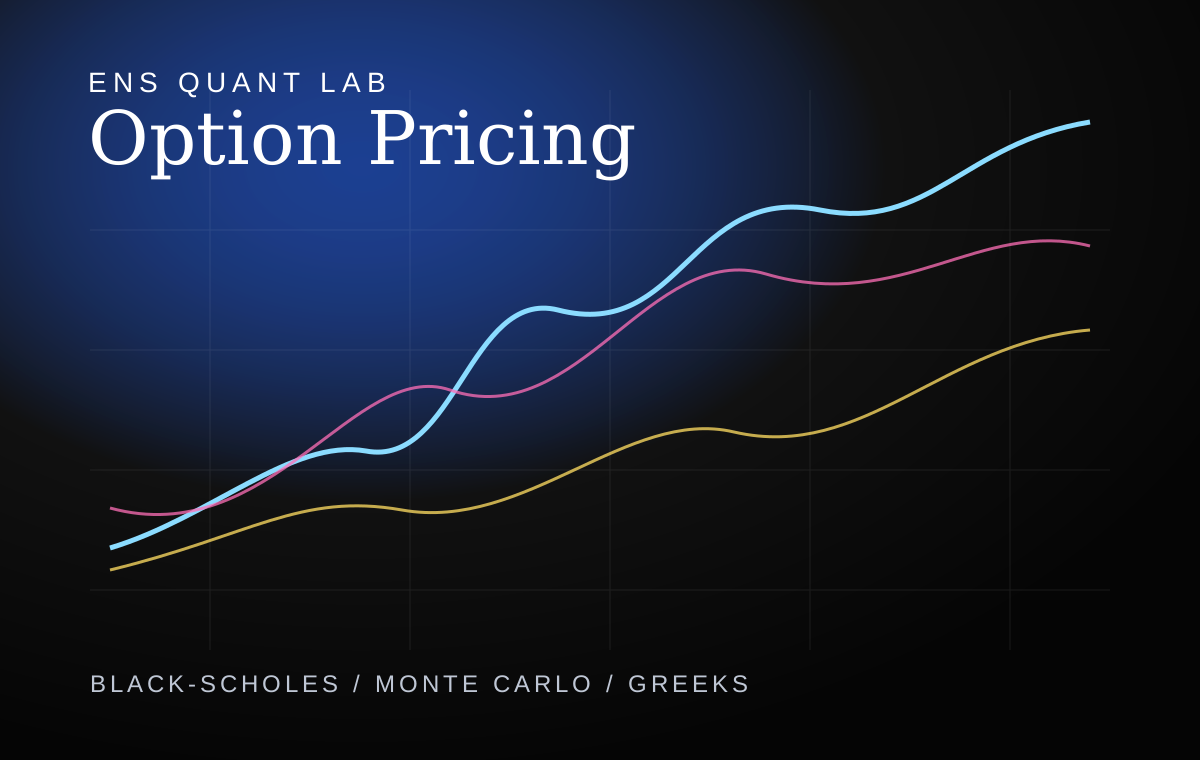
A project built to explain the system behind the surface.
A structured case study around option pricing, scenario generation and risk communication. The objective is not to decorate finance, but to make uncertainty readable.
Pricing models are often presented as formulas or notebooks. The challenge is to expose the assumptions, path behaviour and sensitivity logic in a format that a technical reader can inspect quickly.
The flow starts with the payoff definition, then moves through path simulation, volatility and rate assumptions, confidence bands and a final interpretation layer. Monte Carlo thinking is used as a visual and analytical backbone.
A finance-oriented explanatory page that feels closer to a technical product demo than a generic portfolio entry.
Black-Scholes intuition, Monte Carlo paths and Greeks in one readable layer.
The chart runs a geometric Brownian motion engine in the browser. Change the scenario and the paths, confidence fan, terminal payoff and risk summary update together.
Risk-neutral dynamics
dSt = rStdt + σStdWt
Under the risk-neutral measure, drift becomes the short rate. The option price is the discounted expectation of the terminal payoff.
Discounted payoff
C = e-rT E[(ST - K)+]
Monte Carlo estimates the expectation path by path. Black-Scholes gives the closed-form benchmark used to check the simulation.
Sensitivity layer
Δ = N(d1) · Γ = φ(d1) / Sσ√T
The interface separates price from exposure: delta for directional risk, gamma for convexity and vega for volatility sensitivity.
What the page documents.
- Python simulation core
- Scenario controls for volatility, maturity and rate assumptions
- Visual layer for path dispersion and terminal payoff distribution
- Clear separation between model inputs, computation and interpretation
Why it belongs inside ENS.
This case study is designed as an explanatory page: context first, then method, then outputs. It avoids hiding behind screenshots and makes the thinking visible.
The visual language stays close to the existing ENS site: dark accents, strong spacing, restrained motion and clear editorial hierarchy.
your project into a success story.